

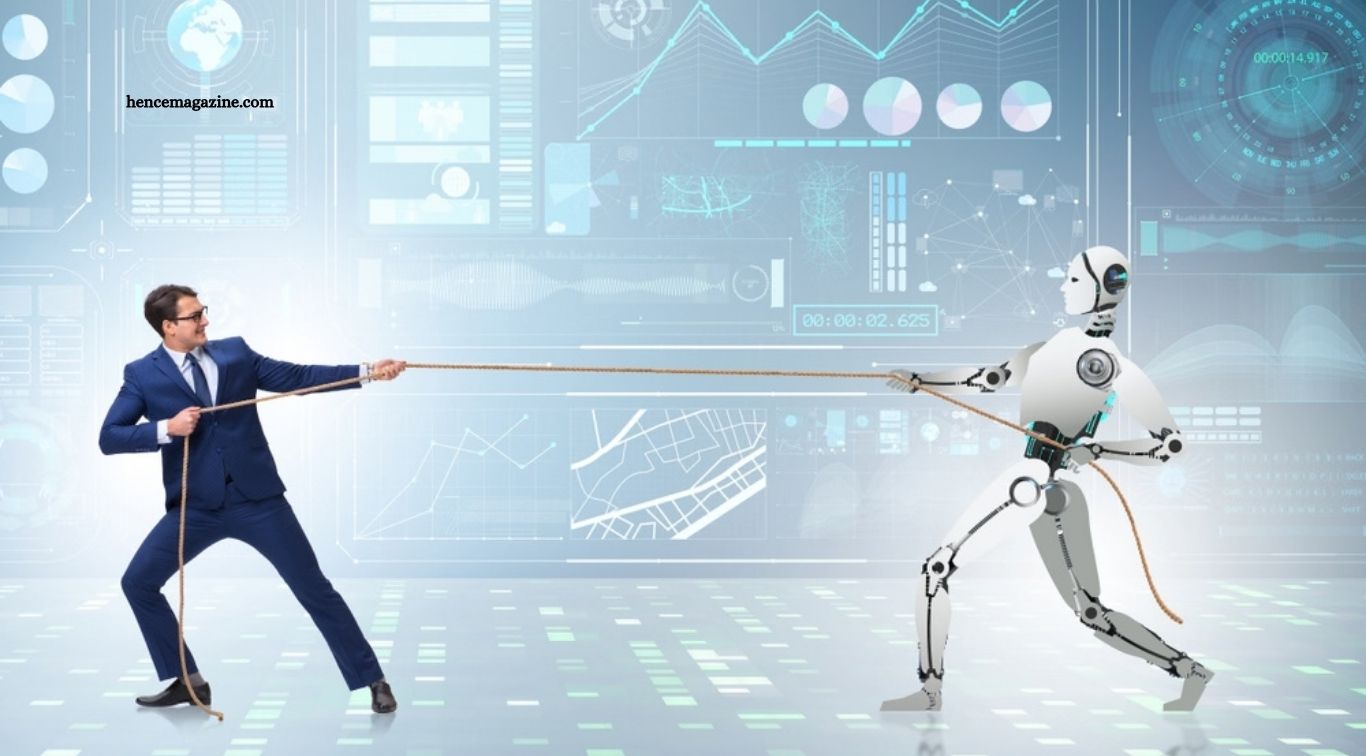
Artificial Intelligence (AI) has changed how people work, communicate, learn, and solve problems. From virtual assistants and recommendation systems to advanced data analysis and content creation, AI can perform tasks that once required human intelligence. However, AI and human intelligence are fundamentally different.
Human intelligence comes from the brain, emotions, experiences, and biological processes. Artificial intelligence is created through algorithms, data, computing systems, and machine learning models. Understanding the difference between artificial intelligence and human intelligence helps businesses, students, professionals, and everyday users understand what AI can—and cannot—do.
Read More: Best Laptops for Work, Gaming, and Everyday Use
What Is Artificial Intelligence?
Artificial Intelligence refers to computer systems designed to perform tasks that normally require human intelligence. These tasks can include learning from data, recognizing patterns, understanding language, making predictions, solving problems, and generating content.
Modern AI systems use technologies such as machine learning, deep learning, natural language processing, and computer vision. AI can process enormous amounts of information quickly and identify patterns that may be difficult for humans to detect.
For example, AI can analyze thousands of documents within minutes, recommend products based on user behavior, detect unusual financial transactions, or generate text from a simple prompt. However, AI does not think exactly like a human. Its capabilities depend on its training data, algorithms, computing resources, and system design.
What Is Human Intelligence?
Human intelligence is the natural ability to learn, understand, reason, adapt, communicate, create, and make decisions. It develops through biological processes, education, personal experiences, social interaction, and environmental influences.
Humans can understand context, emotions, culture, humor, ethics, and abstract ideas. People can also make decisions when information is incomplete and adapt their behavior based on new situations.
Human intelligence is not limited to processing information. It also involves curiosity, imagination, empathy, intuition, self-awareness, and emotional understanding.
Artificial Intelligence vs Human Intelligence: Key Differences
The major differences between AI and human intelligence can be understood through several important factors.
Learning Ability
AI learns primarily from data, algorithms, and predefined training processes. Machine learning models identify patterns from large datasets and use those patterns to produce predictions or responses.
Humans learn through education, observation, experience, mistakes, interaction, and reasoning. A person can often learn a new concept from only a few examples.
Key difference: AI generally requires large amounts of relevant data, while humans can often learn effectively from limited experience.
Speed and Processing Power
AI has a major advantage when it comes to processing large amounts of information. Computers can analyze millions of records in a short period.
Human brains cannot match computer systems in raw computational speed. However, humans can combine information with context, experience, intuition, and judgment.
Key difference: AI is generally faster at large-scale data processing, while humans are stronger at contextual understanding.
Creativity
AI can generate images, music, articles, videos, designs, and other forms of content. Generative AI has made machine-assisted creativity increasingly accessible.
Human creativity is influenced by emotions, memories, culture, imagination, personal experiences, and individual perspectives.
AI can produce impressive creative outputs, but human creativity involves personal intention and lived experience.
Key difference: AI can generate creative content from learned patterns, while human creativity is connected to consciousness, experiences, emotions, and personal expression.
Emotional Intelligence
Humans naturally experience emotions and can understand emotional signals through facial expressions, tone, body language, and personal interaction.
AI can recognize certain emotional patterns from text, speech, or images. However, recognizing an emotion is different from actually experiencing it.
For example, an AI system may identify that a message sounds frustrated, but it does not experience frustration in the human sense.
Key difference: Humans experience emotions; AI can analyze and respond to emotional information without possessing human emotional experiences.
Decision-Making
AI can make predictions and recommendations based on data and predefined objectives. It can support decisions in areas such as finance, healthcare, marketing, logistics, and business operations.
Humans consider factors that may not appear in datasets, including values, ethics, personal responsibilities, social consequences, and intuition.
Key difference: AI relies heavily on data and programmed objectives, while humans can combine evidence with values, experience, and judgment.
Adaptability
Humans can adapt to unfamiliar environments and unexpected situations with relatively little instruction. A person can apply knowledge from one situation to another and develop new strategies.
AI systems usually perform best within the conditions for which they were designed and trained. Although modern AI can generalize across many tasks, unexpected situations can still produce incorrect or unreliable results.
Key difference: Humans generally have broader real-world adaptability, while AI performs according to its capabilities, training, and system design.
Memory
AI systems can store and retrieve enormous amounts of digital information when properly designed and connected to relevant data sources.
Human memory is more complex. People may forget information, reconstruct memories, or remember events differently over time. At the same time, human memory is strongly connected to emotions and personal experiences.
Key difference: AI can provide highly efficient information storage and retrieval, while human memory is closely connected to experience and meaning.
Common Sense
Common sense allows humans to make practical judgments based on everyday knowledge and experience.
AI systems have improved significantly in reasoning and contextual understanding, but they can still produce answers that sound convincing while being incorrect. This is often referred to as an AI hallucination.
Key difference: Humans naturally develop common-sense understanding through real-world experience, while AI must learn patterns from data and system interactions.
Artificial Intelligence vs Human Intelligence Comparison
| Feature | Artificial Intelligence | Human Intelligence |
|---|---|---|
| Origin | Created by humans | Biological |
| Learning | Data and algorithms | Experience, education, observation |
| Processing speed | Extremely fast | Comparatively slower |
| Memory | Large-scale digital storage | Limited and experience-based |
| Creativity | Pattern-based generation | Imagination and personal experience |
| Emotions | Can recognize emotional patterns | Experiences emotions |
| Adaptability | Depends on training and design | Highly adaptable |
| Decision-making | Data and programmed objectives | Data, experience, values, and judgment |
| Common sense | Limited and developing | Naturally developed |
| Consciousness | No established human-like consciousness | Self-aware human experience |
Advantages of Artificial Intelligence
AI offers several benefits that make it valuable across different industries.
Faster Data Analysis
AI can process large datasets much faster than humans. This makes it useful for research, forecasting, fraud detection, customer analysis, and business intelligence.
Automation
AI can automate repetitive tasks, allowing employees to focus on more complex responsibilities. Automation can improve productivity while reducing manual workload.
Consistent Performance
AI systems can perform repetitive tasks consistently without fatigue. A properly designed system can follow the same process thousands or millions of times.
24/7 Availability
AI-powered systems can operate continuously. Chatbots, automated monitoring tools, and digital assistants can provide services outside traditional working hours.
Advantages of Human Intelligence
Despite rapid AI development, human intelligence remains essential.
Emotional Understanding
Humans can understand feelings, relationships, social situations, and emotional needs in ways AI cannot genuinely experience.
Critical Thinking
People can question assumptions, evaluate complex situations, and consider ethical or social consequences.
Original Perspective
Human experiences create unique viewpoints. Two people can interpret the same situation differently because of their backgrounds, memories, values, and experiences.
Adaptability
Humans can respond creatively to unexpected circumstances without requiring a complete retraining process.
Can AI Replace Human Intelligence?
AI can replace or automate certain tasks, but replacing human intelligence entirely is a much more complex challenge. AI is highly effective at repetitive work, data processing, pattern recognition, optimization, and many structured tasks. Humans remain especially valuable in areas involving empathy, leadership, ethical judgment, interpersonal communication, creativity, and complex real-world decision-making.
The future is more likely to involve collaboration between humans and AI rather than complete replacement of humans. For example, an AI system can analyze thousands of data points, while a human professional can interpret the findings, consider broader consequences, and make the final decision.
Human Intelligence and AI Working Together
The combination of AI and human intelligence can produce better results than either one working alone. AI can provide speed, automation, pattern recognition, and large-scale analysis. Humans can provide judgment, creativity, emotional understanding, ethical reasoning, and real-world context. This combination is often called human-AI collaboration.
Businesses can use AI to automate routine processes while allowing employees to focus on strategy and innovation. Students can use AI as a learning assistant while developing their own critical-thinking skills. Professionals can use AI to analyze information while retaining responsibility for important decisions.
The Future of AI and Human Intelligence
AI technology will continue to develop, becoming more capable of handling complex tasks and interacting naturally with people. However, technological progress does not eliminate the unique characteristics of human intelligence.
The most valuable future skill may not be choosing between AI and human intelligence. Instead, it may be learning how to use both effectively.
People who understand AI limitations while strengthening uniquely human abilities—such as creativity, communication, critical thinking, adaptability, and emotional intelligence—can gain an advantage in an increasingly AI-driven world.
Frequently Asked Questions
What is the main difference between AI and human intelligence?
AI relies on algorithms and data, while human intelligence uses experience, emotions, reasoning, and creativity.
Is AI smarter than humans?
AI can outperform humans in specific tasks, but humans remain stronger in creativity, emotional understanding, adaptability, and common-sense reasoning.
Can AI replace human intelligence?
AI can automate many tasks, but it cannot fully replace human judgment, empathy, creativity, and ethical decision-making.
Which is faster, AI or human intelligence?
AI can process large amounts of information much faster than humans, especially during repetitive or data-intensive tasks.
Can artificial intelligence feel emotions?
No. AI can recognize and respond to emotional patterns, but it does not experience emotions like humans.
Will humans and AI work together in the future?
Yes. Human-AI collaboration can combine machine speed and data processing with human creativity, judgment, and emotional intelligence.
Conclusion
Artificial Intelligence and human intelligence have different strengths. AI excels at speed, automation, data processing, pattern recognition, and repetitive tasks. Humans excel at emotional understanding, creativity, adaptability, common sense, ethical reasoning, and contextual judgment. AI is becoming increasingly powerful, but it should not be viewed simply as a replacement for human intelligence. The strongest approach is to combine machine capabilities with human skills.

1 Comment
Pingback: Emerging Technologies That Will Shape the Next Decade - Hence Magazine